How to Avoid Outdoor Kitchen Fire Risks: The Authority Guide
The transition of the domestic kitchen into the open air has introduced a complex set of thermodynamic variables that many homeowners and general contractors often underestimate. While the appeal of an expansive exterior culinary suite is undeniable, the engineering required to manage high-output thermal energy in an environment subject to wind, moisture, and combustible organic matter is significant. How to Avoid Outdoor Kitchen Fire Risks. This is no longer merely about placing a grill on a patio; it is about managing a high-performance fuel system integrated into a residential structure.
Safety in this context is frequently treated as a secondary concern to aesthetics, yet the statistics regarding residential property damage from exterior cooking fires suggest a different priority is needed. A high-end outdoor grill can generate upwards of 100,000 BTUs—equivalent to the heating capacity of a small furnace—housed within a cabinetry system that may or may not be equipped to dissipate that heat. When these systems are installed under pergolas, near vinyl siding, or within “combustible” cabinetry without proper insulation, the risk of a structure fire becomes a matter of “when” rather than “if.”
As we move into 2026, the regulatory landscape is shifting. Insurance providers and municipal fire marshals are increasingly scrutinizing outdoor kitchen installations, demanding adherence to stricter “clearance-to-combustibility” standards. This article serves as a definitive technical reference for mitigating these hazards. By deconstructing the physics of exterior heat transfer and the chemistry of grease fires, we provide a framework for creating a social space that is as resilient as it is functional.
How to Avoid Outdoor Kitchen Fire Risks
To fundamentally address how to avoid outdoor kitchen fire risks, one must move beyond the simple presence of a fire extinguisher. The methodology of safety is built upon three pillars: Material Non-Combustibility, Ventilation Engineering, and Fuel-Path Integrity. A failure to address even one of these pillars creates a “latent hazard”—a risk that remains hidden until a specific set of environmental conditions, such as a high-wind day or a grease flare-up, triggers a catastrophic event.
A primary misunderstanding among property owners is the definition of “combustible.” Many believe that because an island is covered in stone veneer, it is fireproof. In reality, if the internal frame of that island is constructed from pressure-treated lumber, it is a combustible structure. The heat from a high-performance grill can transfer through stone and mortar via conduction, eventually reaching the ignition temperature of the wood frame inside. This is known as “pyrolysis”—the chemical decomposition of wood caused by long-term heat exposure—which lowers the ignition point of the wood over time, making a fire inevitable.
Oversimplification also plagues the area of ventilation. In an indoor kitchen, a vent hood’s primary job is to remove odors and smoke; in an outdoor kitchen, especially one located under a roof or pavilion, the vent hood is a critical safety device. Without it, trapped heat and unburned gas can accumulate in “pockets” under the ceiling. If a gas leak occurs, these pockets can reach an explosive concentration. True mastery of safety involves a “system-wide” view where every material, from the sub-frame to the overhead structure, is evaluated for its thermal resilience.
Contextual Background: The Physics of Exterior Thermal Management
Historically, outdoor cooking was a detached activity. A standalone charcoal grill sat in the middle of a concrete patio, far from any structure. The risk was localized and easily managed. The modern “Integrated Outdoor Kitchen” has changed this dynamic by bringing the grill closer to—or even inside—the building envelope. This proximity has introduced the “Chimney Effect,” where heat and embers are channeled upward toward eaves and soffits.
The evolution of materials has also played a role. The rise of composite decking and synthetic “faux-wood” finishes has increased the fuel load of the average backyard. While these materials are low-maintenance, they are often highly flammable and produce toxic smoke when ignited. Consequently, the engineering of the outdoor kitchen has had to adapt, borrowing techniques from commercial restaurant kitchens, such as the use of stainless steel “insulating jackets” for grills and high-velocity ventilation systems designed to exhaust heat before it can affect the surrounding architecture.
Conceptual Frameworks and Safety Mental Models
Effective risk mitigation requires a shift in how the homeowner and contractor perceive the kitchen.
The “Zone of Ignition” Model
This model divides the kitchen into three zones: the Plasma Zone (the grill interior), the Conductive Zone (the cabinetry and counters), and the Convective Zone (the air and structures above). Safety is achieved by ensuring that no combustible material exists in the Conductive Zone and that the Convective Zone is either open to the sky or protected by a thermal shield.
The “Passive vs. Active” Defense
Passive defense includes using non-combustible materials like steel studs and cement board. Active defense includes gas-leak sensors and automatic shut-off valves. A flagship plan never relies on active systems alone; it uses active systems as a backup to a robust passive design.
The “BTU-to-Volume” Ratio
This framework calculates the total heat output of all appliances (grills, side burners, pizza ovens) against the cubic footage of the outdoor space. If the “thermal density” is too high for a covered area, the plan must be modified to include higher ceilings or mechanical exhaust.
Key Categories of Fire Mitigation Systems
| Category | Primary Function | Trade-offs | Ideal Application |
| Insulated Grill Jackets | Prevents heat transfer to cabinets | Significant extra hardware cost | Wood or combustible islands |
| High-CFM Vent Hoods | Removes heat/gas from ceilings | Aesthetic bulk; requires power | Covered patios or pavilions |
| Non-Combustible Framing | Eliminates the fuel source | Higher labor for steel studs | All permanent installations |
| Automatic Timer Valves | Prevents gas buildup from leaks | Limited run-time for slow cooks | Residential propane/NG lines |
| Thermal Heat Shields | Protects vertical walls/siding | Visual interruption | Grills placed near home siding |
Realistic Decision Logic
The absolute “best” safety configuration is a Steel Frame Island paired with an Insulated Jacket. This combination ensures that even if a grease fire occurs inside the grill, the structure of the island will not ignite. If the budget is constrained, the first item to cut should be aesthetic (like a high-end countertop) rather than a safety feature like the insulated jacket.
Detailed Real-World Scenarios How to Avoid Outdoor Kitchen Fire Risks
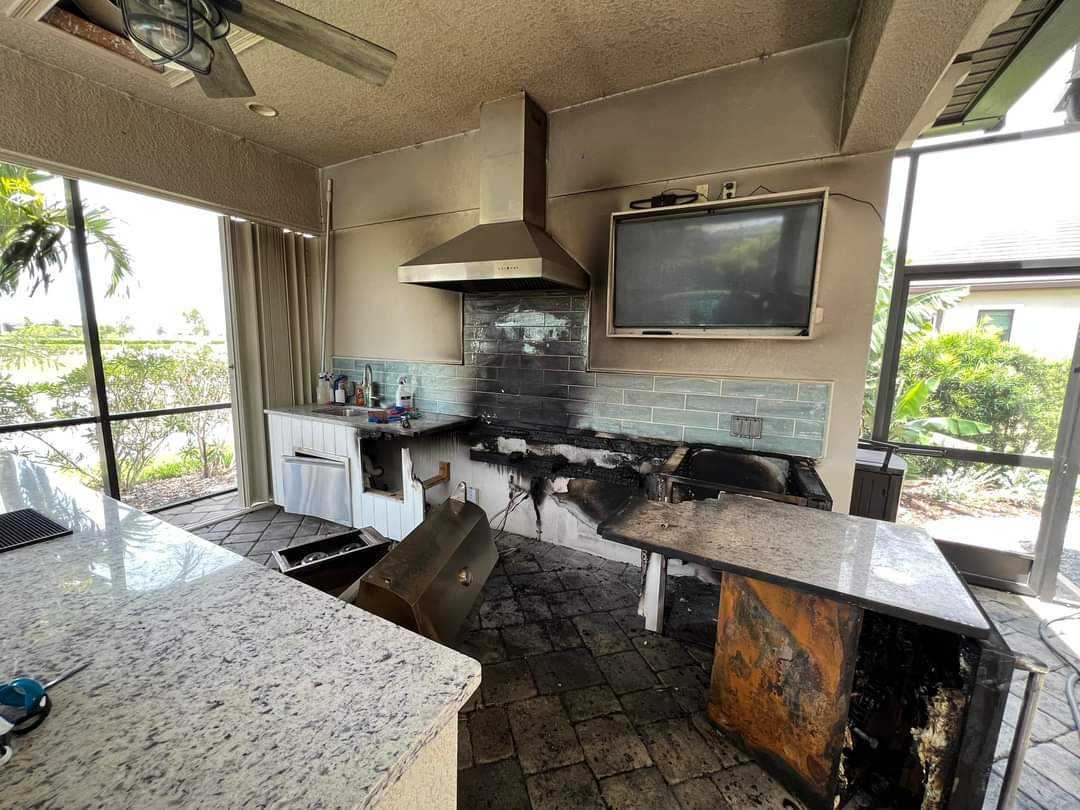
Scenario 1: The “Siding Melt” Failure
A homeowner installs a powerful 42-inch grill 12 inches away from their house, which is clad in vinyl siding.
-
The Physics: Even without a fire, the radiant heat from the back of the grill reaches 250°F.
-
The Failure: The vinyl siding warps and melts, exposing the flammable plywood sheathing underneath.
-
The Solution: A minimum 36-inch clearance or the installation of a stainless steel heat shield with a 1-inch air gap.
Scenario 2: The “Under-Cabinet” Gas Pocket
A modular kitchen is built without “Toe-Kick” vents. A small leak develops in a gas hose under the grill.
-
The Physics: Propane is heavier than air and pools at the lowest point.
-
The Failure: The homeowner ignites the grill; the spark reaches the pooled gas under the cabinets, resulting in a localized explosion.
-
The Solution: Installing high and low vents in the cabinetry to allow gas to dissipate naturally.
Planning, Cost, and Resource Dynamics
Safety is an investment in “Loss Prevention.” While safety features add 10–15% to the initial build cost, they prevent the 100% loss of the asset and the home.
Safety-Critical Cost Table
| Component | Estimated Cost (USD) | Resource Requirement | Risk of Omission |
| Insulated Grill Jacket | $600 – $1,800 | Matches grill brand | Structural fire; pyrolisis |
| Steel Stud Framing | $1,200 – $3,500 | Metal-working tools | Cabinet ignition |
| Exterior Vent Hood | $2,500 – $6,000 | Roofer & Electrician | Smoke damage; gas pockets |
| Gas Safety Timer | $200 – $500 | Licensed Plumber | Undetected gas leaks |
| Fire-Rated Backer Board | $400 – $900 | Masonry specialist | Wall/Siding failure |
Tools, Strategies, and Technical Support Systems
-
Thermal Imaging Cameras: Professionals use these during the first “burn-in” to identify hot spots where heat might be transferring to hidden combustible elements.
-
Manometer Pressure Tests: Conducted by plumbers to ensure the gas line is airtight from the meter to the burner.
-
Automatic Gas Shut-off (Seismic/Flow): Valves that trigger if they sense an unusual surge in gas flow (indicating a burst pipe) or a seismic event.
-
Stainless Steel Flex-Lines (Whistle-Free): Using high-quality connectors that resist corrosion and prevent the vibration that can loosen fittings over time.
-
Dedicated Class K Fire Extinguishers: Unlike standard extinguishers, Class K is designed specifically for high-heat vegetable oil and animal fat fires common in kitchens.
-
Dual-Point Venting: Ensuring every cabinet island has vents at the top (for natural gas, which rises) and the bottom (for propane, which sinks).
Risk Landscape: Compound Failures in Fuel and Heat
The most dangerous fires are not caused by a single mistake but by “The Error Chain.”
-
Example: A homeowner forgets to clean the grease tray (Error 1). They leave the grill on “High” to preheat and go inside (Error 2). A gust of wind blows a leaf into the grease tray (Error 3).
-
Compounding Effect: The grease ignites, the heat melts the gas regulator because there was no heat shield, and the fire is now fed by a pressurized gas line.
This taxonomy of risk highlights that maintenance is a safety feature. A clean grill is a safe grill.
Governance, Maintenance, and Seasonal Safety Adaptation
Safety requires a “Review Cycle.”
-
The “First Burn” Audit: Check for any odors of melting plastic or unusual smoke from inside the cabinetry.
-
The Bi-Annual Degreasing: Removing carbonized grease from the interior of the grill and the vent hood filters. Grease is a fuel source; removing it reduces the maximum possible fire intensity.
-
The Leak Check (Spring): Using a soapy water solution on all gas joints after the winter freeze-thaw cycle, which can loosen fittings.
-
Spider/Nest Inspection: Insects are attracted to the smell of gas and often build nests in “venturi tubes,” causing gas to back up and ignite behind the control panel.
Measurement, Tracking, and Safety Evaluation
How do you measure the success of your fire prevention strategy?
-
Leading Indicator: “Temperature Delta”—measuring the temperature of the cabinet exterior while the grill is at max heat. It should not exceed 50°F above ambient.
-
Lagging Indicator: Number of flare-ups per month. Frequent flare-ups indicate a failure in grease management governance.
-
Qualitative Signal: The absence of “scorching” or discoloration on any surface within 3 feet of the cooking zone after one year of use.
Common Misconceptions and Industry Myths
-
Myth: “A stone countertop is a heat sink and protects the cabinets.”
-
Correction: Stone (especially granite) can crack from thermal shock and is an excellent conductor. It moves heat to the frame; it does not “absorb” it safely.
-
-
Myth: “My grill is ‘built-in’ so it doesn’t need an insulated jacket.”
-
Correction: Most grills are designed for air circulation. “Built-in” simply means it lacks a cart. Unless the manual specifies it can be installed in a combustible cabinet, a jacket is mandatory.
-
-
Myth: “Propane tanks are safer than natural gas lines.”
-
Correction: Propane tanks are pressurized vessels. If a fire occurs, the tank can undergo a BLEVE (Boiling Liquid Expanding Vapor Explosion). A natural gas line has a shut-off valve far from the heat source.
-
Ethical and Practical Considerations
There is an ethical dimension to outdoor kitchen safety regarding “Neighborly Risk.” In dense suburban environments, a fire in your outdoor kitchen is likely to spread to the neighbor’s fence or home. Proper planning is a social responsibility. Practically, this involves respecting “Setback Requirements” even if local permits don’t strictly enforce them. Building for the “Worst-Case Scenario” is the hallmark of a responsible homeowner.
Conclusion
The pursuit of how to avoid outdoor kitchen fire risks is fundamentally an exercise in respecting the laws of thermodynamics. As we integrate higher BTU outputs into more complex residential designs, the margin for error narrows. The definitive outdoor kitchen is one where the “Passive Defense” of steel and stone is supported by a rigorous “Active Governance” of cleaning and inspection. By treating the exterior kitchen with the same engineering respect as an industrial facility, we preserve the social value of the space without compromising the safety of the home. Excellence in design is not measured by the beauty of the flame, but by our ability to contain it.